
The Hutton Memorial Garden in Edinburgh occupies the precise spot where Hutton built his house at St John’s Hill, when he moved back to Edinburgh in 1770. He lived in this house with his three sisters, and it was here that he wrote his books and papers. Twenty-seven years later, this is where he died on 26 March 1797 aged seventy.
He was buried in Greyfriars Kirkyard in Edinburgh where his grave remained unmarked until 1947, the 150th Anniversary of his death when the then Lord Provost, Sir John Falconer, unveiled a plaque commemorating Hutton as the Founder of Modern Geology.
To mark the bicentenary of his death, an International Conference was organised by the Royal Society of Edinburgh, which Hutton co-founded in 1783, in the Royal College of Physicians of Edinburgh. During the meeting, on the afternoon of Wednesday 6th August 1997, a bronze plaque was unveiled at the site of Hutton’s house in the names of The Royal Society of Edinburgh and the Edinburgh Geological Society. Participating in the unveiling ceremony, attended by delegates and invited guests, were David Land, President of the Edinburgh Geological Society, Fraser Morrison CBE, Executive Chairman of Morrison Construction Group plc, Councillor Brian Weddell, Chairman of the Housing Committee of the City of Edinburgh Council, Professor Sir Stewart Sutherland, Principal and Vice-Chancellor of the University of Edinburgh and Professor Malcolm Jeeves CBE, President of the Royal Society of Edinburgh.
The bronze plaque was mounted on a single block of Clashach stone from the southern edge of the Moray Firth, a Triassic dune-bedded sandstone from a coastal quarry north of Elgin. Inscribed below the plaque, is the famous final sentence of Hutton’s 1788 paper: ‘…we find no vestige of a beginning, no prospect of an end’.
At the unveiling ceremony in 1997, the stone bearing the bronze plaque was surrounded by other large boulders intended to illustrate two of the main themes of Hutton’s remarkable geological work.
As Hutton’s own collection of rocks had long-since disappeared, these were specially brought to St. John’s Hill. Two boulders showing granitic veins came from the locality above the Duke of Atholl’s hunting lodge in Glen Tilt which John Clerk of Eldin visited with James Hutton. These were provided by courtesy of Charlie Pirie, the Duke’s Gamekeeper. These illustrate Hutton’s work on the origin of granite from September 1785. The other three boulders were of conglomerate carried by ice and water and came from Barbush on the edge of Dunblane. These illustrate Hutton’s understanding of the cyclicity of geological processes.


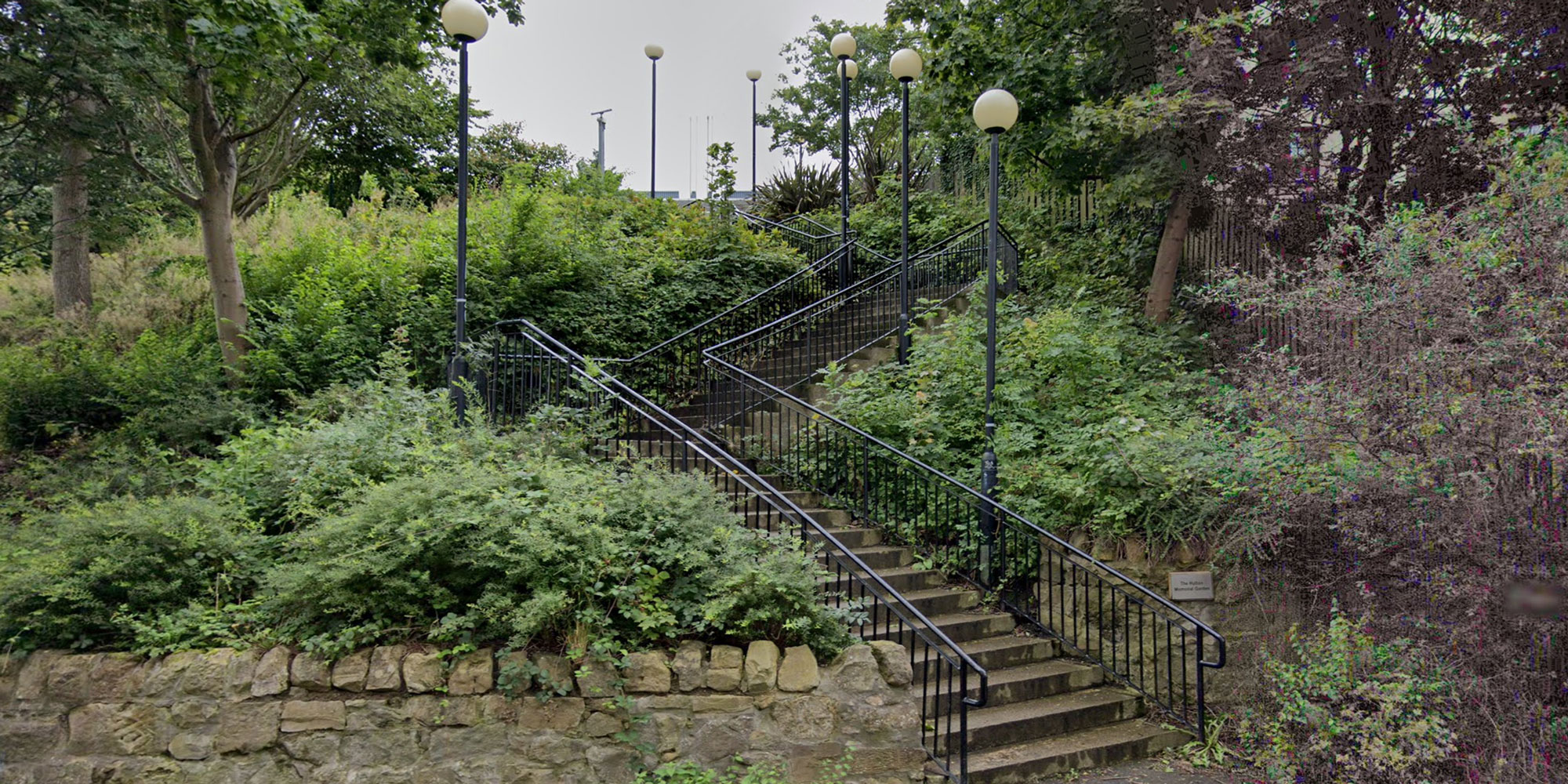
Directions to the Hutton Memorial Garden
- The Garden is located at St John’s Hill, Edinburgh and is best approached from Holyrood Road.
- A hundred metres east of the junction with the Pleasance, turn into Viewcraig Gardens and walk up past the entrance to the car park.
- About 50 m from Holyrood Road, a flight of steps leads up to the Garden.
- For disabled access, the University car park can be reached through the arch north of the Sports Union, opposite the terminated end of Drummond Street. At the far end of the car park, on the left, a ramp leads down to the Garden.
Google Map